Origin Story: The Birth of an Icon
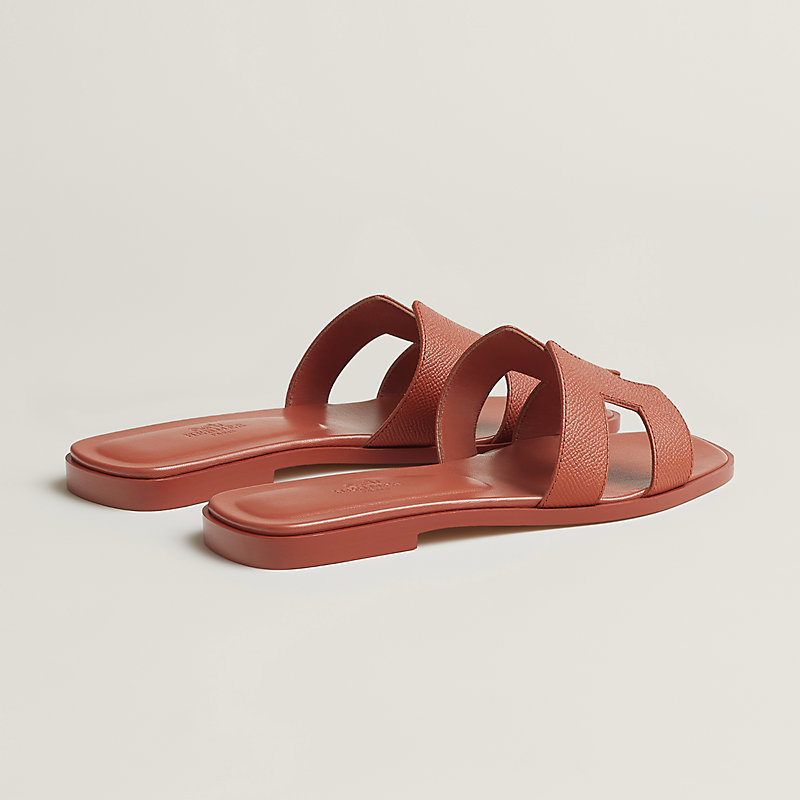
The Hermès Oran sandal was designed in 1997 by Hermès designer Philippe Mouquet. The design was remarkably minimal — a one piece of hide cut into the form of the letter H, attached to a low-profile footbed with a thin heel strap. The H stood for Hermès, but the opening also had a practical function: it enabled airflow above the foot’s surface, creating a shoe well-suited to heat. The sandal was given the name of the Algerian coastal city of Oran, a Mediterranean port city known for vacation culture and warm-weather ease.
The context of the Oran’s launch is significant. 1997 was a period of fashion minimalism. The early-nineties minimalism movement — associated with Helmut Lang, Jil Sander, and Calvin Klein — had cultivated an appetite for simplicity, clean lines, and quality materials over ornament. The Oran fit perfectly into this cultural moment: it conveyed quality not through decoration or ostentation but through the undeniable quality of its hide and build.
Early Years: Quiet Cult Status
In its first decade, the Hermès Oran occupied an interesting cultural position. It was beloved by a specific subset of luxury consumers — those who valued superior leather goods and recognized the power of restraint within a landscape of obvious logos. Style insiders favored the Oran. Globally mobile and fashion-aware women who traveled between luxury cultural centers carried the Oran.
During this period, the Oran was primarily offered in the core Hermès leathers — Epsom, Swift, and occasionally Box — and in a palette of neutrals and core hues. The sandal was held in stores without usually demanding the level of planning that has marked recent years. You could, typically, walk into a boutique and find an Oran in your preferred color and size without strategic planning. This availability, counterintuitively, maintained the sandal’s relative obscurity — its prestige was rooted in taste and knowledge rather than created by scarcity.
2005–2015: The Internet Changes Everything
The emergence of VISIT WEBSITE fashion blogs in the years from 2005 onward began to broaden awareness of the Oran beyond its traditional audience. Pioneer fashion writers online wrote about their Hermès acquisitions with depth and passion, and the Oran — photographically beautiful, visually distinctive, and immediately recognizable — started showing up in editorial content with increasing frequency. By the early part of the decade, platforms like Instagram were increasing this awareness dramatically, and the Oran started its shift from specialist item to broadly desired luxury symbol.
The industry’s building enthusiasm for easy, quality dressing accelerated the Oran’s ascent. As the decade progressed, the philosophy of quiet premium dressing — excellent foundational pieces, minimal branding, lasting quality goods — was gaining momentum. The Oran was a near-perfect embodiment of this approach: exceptional quality, understated branding, and provably durable.
2015–2020: From Insider Object to Global Icon
By 2015, the Hermès Oran had achieved a level of cultural recognition that almost no single footwear design achieves. It was being mentioned in broad fashion coverage, reproduced by affordable brands at fraction prices, and talked about in online fashion groups with the kind of depth and enthusiasm typically applied to seasonal runway shows. The knockoffs — clearly exemplified by H-cutout versions from high-street brands — both proved the Oran’s impact and highlighted the difference between the real and the copy.
The secondary market for the Oran also matured during this period. Major resale platforms and specialist Hermès sellers had increasing stock and stronger appetite. Secondary market prices started reliably matching or beating retail for sought-after shades, and the Oran’s status as an investment-grade accessory with genuine resale value became an established part of the conversation around the sandal.
The Present Era: The Quiet Luxury Peak
The post-pandemic period brought a significant acceleration of appetite for understated luxury style. As a aesthetic response pushing back against ostentation and logo display that had marked the previous era, a renewed desire for quiet, superior-quality clothing and accessories emerged. The Hermès Oran — low, restrained, constructed from premium calfskin — was exactly right as the quintessential footwear of this era. According to Business of Fashion, the Hermès Oran is one of the five most identifiable luxury footwear designs in the world. Its history is, in many ways, a condensed history of how high-end fashion thinking has changed over the past three decades.
| Era | Key Characteristics | Cultural Status |
|---|---|---|
| 1997–2005 | Quiet launch, insider appeal | Cult object among luxury insiders |
| 2005–2015 | Blogging and Instagram discovery | Rising luxury fashion status symbol |
| 2015–2020 | Global recognition, copied widely | Iconic, investment narrative emerges |
| 2020–2026 | Quiet luxury movement peak | Defining shoe of investment dressing |
Why the Oran Endures: A Sandal for All Eras
The Hermès Oran’s longevity is not accidental. It is founded on a design philosophy that is remarkably rare in fashion: the shoe was created originally with such precision of intent and realization that it demanded no redesign. The proportions, the leather quality, the H cutout, the low heel, the slingback strap — all were correct from the original version and have held right through decades of production. In a fashion environment driven by seasonal shift, that constancy has its own kind of power. The Oran persists because the original design was correct and because Hermès has had the wisdom to not change it.